Black Mold vs. Mildew in Your Attic: How to Tell the Difference (And When to Worry)
Quick Answer: How to Tell Them Apart
The most important distinction between mold and mildew in your attic comes down to how deep the growth goes and how the material underneath is affected. Here is a side-by-side comparison:
| Characteristic | Mildew | Black Mold |
|---|---|---|
| Color | White, gray, light green, or yellowish | Dark green, dark gray, or black |
| Texture | Flat, powdery, or downy | Slimy, fuzzy, or velvety |
| Depth | Surface only, wipes off easily | Penetrates into the material |
| Material damage | Minimal, cosmetic staining | Breaks down wood fibers, causes structural damage |
| Typical location | Exposed surfaces, bathroom vents, attic sheathing | Persistently wet areas, leaks, chronic condensation zones |
| Health risk | Mild irritation for most people | Higher risk, mycotoxin production possible |
| DIY cleanable? | Usually, if under 10 sq ft | No, professional remediation recommended |
Key takeaway: Not all dark-colored growth in your attic is dangerous black mold, and not all light-colored growth is harmless mildew. The location, texture, and extent of the growth matter more than color alone. When in doubt, get it tested.
What Mildew Looks Like in an Attic
Mildew is the less threatening of the two, but it is still a sign that moisture conditions in your attic are off.
In Puget Sound attics, mildew most commonly appears as:
- Flat, powdery patches on the underside of roof sheathing, usually white or light gray
- Thin surface growth near bathroom exhaust fan terminations or around the attic hatch
- Light discoloration on exposed wood that can be wiped away with a damp cloth
Mildew is a surface colonizer. It feeds on dust, organic debris, and surface moisture without significantly damaging the wood underneath. If you wipe a suspicious patch with a cloth and the wood beneath looks sound — no softness, no darkening, no texture change — you are probably dealing with mildew.
The test: Dampen a cloth with a small amount of household bleach solution and wipe the affected area. If the discoloration lifts easily and the wood below appears clean and structurally intact, it is likely mildew. If the staining persists or the wood is discolored beneath the surface, you may be looking at mold that has penetrated deeper.
What Black Mold Looks Like in an Attic
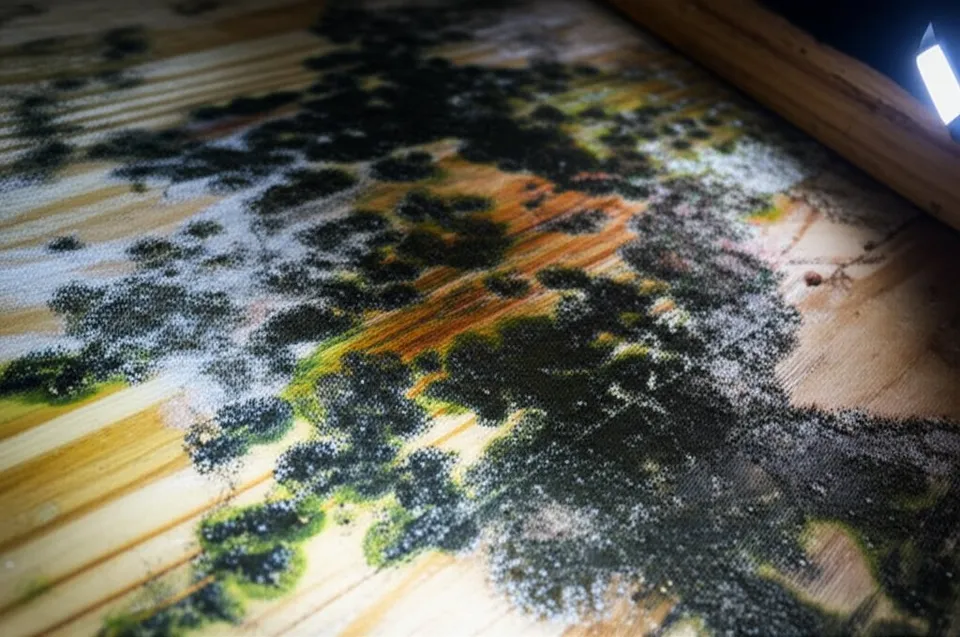
True black mold — specifically Stachybotrys chartarum, the species most people mean when they say “black mold” — looks distinctly different from mildew:
- Dark green to black color that appears wet or slimy when actively growing
- Fuzzy or velvety texture that does not wipe off cleanly
- Clustered, irregular patches rather than thin, even coverage
- Grows on and into the wood, not just on the surface
- The wood underneath is stained, darkened, or soft even after the surface growth is removed
Stachybotrys requires sustained moisture to grow. It does not appear after a single condensation event. If you are seeing black, slimy growth on your attic sheathing or rafters, that area has been wet for an extended period, likely weeks or months.
However, and this is important: not every dark-colored mold is Stachybotrys. There are dozens of common mold species that produce dark pigmentation, including Cladosporium, Aspergillus niger, and Alternaria. Some of these are less concerning than Stachybotrys, and some produce their own health risks. Color alone is not a reliable way to determine the species or the threat level.
Common Misidentifications We See
In our attic inspections across King County and Snohomish County, we frequently see homeowners (and sometimes home inspectors) misidentify what they are looking at. Here are the most common mix-ups:
| What It Looks Like | What People Think It Is | What It Usually Is |
|---|---|---|
| Dark staining on roof sheathing near nails | Black mold | Nail rust staining from condensation on cold metal |
| White crystalline deposits on concrete or masonry | Mold or mildew | Efflorescence (mineral salts leaching through moisture) |
| Gray-green patches on old insulation | Mold | Dust and debris on fiberglass (though mold is possible) |
| Black spots on attic side of ceiling drywall | Black mold | Condensation staining, possibly with early mold |
| Dark discoloration on old wood | Active mold | Age-related wood darkening or old, inactive mold staining |
The distinction between active and inactive mold matters. Old mold staining from a moisture event that has been resolved may leave behind dark marks on wood, but if the moisture source is gone and the growth is no longer active, the health risk drops significantly. Active growth has a fuzzy or slimy texture and produces a musty smell. Old staining is flat, dry, and odorless.
Pro tip: If you are buying a home and the inspection report flags “mold in the attic,” ask whether the inspector actually tested the growth or is going by visual appearance alone. Many inspection reports call anything dark “potential mold” without testing. A $300 to $500 professional mold test tells you exactly what you are dealing with and whether it is active.
Health Risks: When to Actually Worry
The health conversation around mold gets overblown in some cases and underplayed in others. Here is a balanced look at what the science says:
| Growth Type | Health Risk Level | Who’s Most Affected | Typical Symptoms |
|---|---|---|---|
| Surface mildew (small area) | Low | Sensitive individuals | Mild sinus irritation, sneezing |
| Common mold (Cladosporium, Penicillium) | Low to moderate | Allergy and asthma sufferers | Congestion, coughing, eye irritation |
| Black mold (Stachybotrys) | Moderate to high | Everyone, especially immunocompromised | Persistent cough, headaches, fatigue, respiratory issues |
| Large-scale mold (any species, 50+ sq ft) | Moderate to high | Everyone in the household | Chronic respiratory symptoms, worsened allergies |
The key variable is exposure level, which is a function of how much mold is present and how much of its spore load is reaching your living space. A small patch of mildew on one rafter is very different from wall-to-wall mold covering the entire underside of the roof sheathing.
In attics, the stack effect works in your favor somewhat — air tends to move upward through the home and out through the attic, not the reverse. But air movement is never perfectly one-directional. Mold spores from the attic can and do make their way into the living space, especially through the attic hatch, recessed lights, and ceiling penetrations.
Bottom line: Small, localized mildew in an otherwise dry attic is a maintenance issue, not an emergency. Widespread dark mold on structural wood, especially if accompanied by a musty smell in the rooms below, is a health and structural concern that needs professional attention.
Why PNW Attics Are Prone to Both
Attic mold and mildew are not random. In the Pacific Northwest, specific conditions make our attics more vulnerable than homes in drier or colder climates:
Condensation From Below
The number one cause of attic mold in Seattle-area homes is warm, moist air from the living space migrating into the attic and condensing on cold surfaces. Every time you cook, shower, or breathe, you add moisture to the air. That humid air rises through gaps in the ceiling and enters the attic, where it hits the cold underside of the roof sheathing and condenses into liquid water.
Common entry points include:
- Bathroom exhaust fans that vent into the attic instead of through the roof
- The attic hatch with no weatherstripping or insulation
- Recessed lights (especially older, non-IC-rated cans)
- Plumbing and wiring penetrations through the top plates
- Ductwork connections that are not sealed
Pro tip from Sadeq: Bathroom fans vented into the attic instead of outside are one of the top three causes of attic mold I see. If your bathroom fan duct terminates in the attic, that is dumping warm, humid shower air directly onto your roof sheathing every day. Getting that duct extended through the roof is a $200 to $400 fix that prevents thousands of dollars in mold damage.
Inadequate Ventilation
A properly ventilated attic has intake vents (soffit vents along the eaves) and exhaust vents (ridge vent or roof vents near the peak). This allows outside air to flow through the attic, carrying moisture out before it can condense.
Many older Puget Sound homes have insufficient ventilation: blocked soffit vents, no ridge vent, or only a couple of static roof vents that do not move enough air. Without adequate airflow, moisture from condensation accumulates with no way to escape.
Seattle’s Temperature Sweet Spot
Mold thrives between 60 and 80 degrees F. Seattle’s attic temperatures fall in or near this range for much of the year. Even in winter, a poorly insulated attic stays warm enough for mold because heat from the living space below keeps the temperature elevated. We rarely get the hard, sustained freezes that kill mold growth in colder climates.
Testing Options: When and How
If you have found something in your attic and you are not sure whether it is mildew, mold, or just staining, you have several testing options:
| Test Type | Cost | What It Tells You | When to Use |
|---|---|---|---|
| DIY mold test kit | $10-$40 | General presence of mold spores | Screening only, not reliable for identification |
| Professional air quality test | $200-$400 | Species and spore count in the air | When health symptoms are a concern |
| Surface sample (tape lift or swab) | $150-$300 | Species identification on a specific area | When you need to know what type of mold you have |
| Professional inspection + testing | $300-$500 | Comprehensive assessment with lab results | Before remediation or before buying a home |
DIY test kits from the hardware store will almost always come back positive because mold spores are present in every home. They do not tell you the species, the concentration, or whether the level is concerning. For that reason, we generally recommend skipping the DIY kits and going straight to a professional test if you want meaningful answers.
For a complete walkthrough of the remediation process and what to expect, see our mold remediation process guide.
When to Clean It Yourself vs. Call a Professional
| Situation | Handle It Yourself | Call a Professional |
|---|---|---|
| Mildew on non-structural surface, under 10 sq ft | Yes | Not necessary |
| Mold of any color on structural wood (rafters, sheathing) | No | Yes |
| Growth covering more than 10 sq ft | No | Yes |
| Recurring growth after you’ve cleaned it once | No | Yes, moisture source needs diagnosis |
| Any growth with musty smell in living space below | No | Yes, spores are reaching your home |
| Growth found during home inspection/sale | No | Yes, get professional documentation |
| Household members experiencing health symptoms | No | Yes, get tested and remediated |
If your situation falls in the DIY column and you want to handle it yourself, here is the safe approach: wear an N95 respirator, safety goggles, and gloves. Use a commercial mold cleaner or a borax solution. Apply with a brush, scrub the surface, and allow it to dry. Do not use bleach on wood — it does not penetrate deeply enough and can damage wood fibers.
After cleaning, address the moisture source. If you do not fix why the mildew appeared in the first place, it will come back.
For more on identifying mold in other areas of your home, see our guide on signs of mold in your crawl space. And if you are wondering whether your insurance might help cover the cost, our article on insurance coverage for mold remediation in Washington explains what is and is not typically covered.
What Professional Attic Mold Remediation Costs
Here is what attic mold remediation typically runs in the Seattle area:
| Scope | Cost Range | What’s Included |
|---|---|---|
| Small area (under 50 sq ft) | $1,500-$4,000 | Remediation + antimicrobial treatment |
| Moderate (50-200 sq ft) | $3,000-$7,000 | HEPA vacuuming, media blasting, treatment |
| Whole-attic sheathing | $5,000-$10,000+ | Complete remediation + ventilation correction |
| Clearance testing (third-party) | $300-$500 | Independent verification of successful remediation |
These costs typically include identification and correction of the moisture source. A remediation company that treats the mold without fixing the ventilation or condensation issue is setting you up for a callback. Our mold remediation service addresses both the growth and the conditions that caused it.
If you also need old, contaminated insulation removed and replaced, our attic cleanup service handles removal, sanitization, and new insulation installation as a coordinated project.
Get Your Attic Assessed
If you have found dark growth in your attic and you are not sure what you are looking at, a professional assessment takes the guesswork out. We inspect attics across King County and Snohomish County and give you a clear answer: what the growth is, whether it is active, what caused it, and what needs to happen.
Request a free attic assessment — we will identify the issue, explain your options, and give you honest pricing. No pressure, no upselling, just straight answers about what your attic needs.

"Homeowners see something dark in the attic and immediately think black mold. I'd say eight out of ten times it's actually mildew or a non-toxic mold species. That doesn't mean you should ignore it — it's still a sign of a moisture problem — but it's not the emergency people think it is. Get it tested before you panic."
Sadeq, Owner
"The real question isn't what type of mold it is — it's why it's growing in the first place. Whether it's Stachybotrys or Cladosporium, the moisture source is the same. Fix the ventilation problem, fix the moisture problem, and the mold doesn't come back regardless of the species."
Sadeq, Owner
Frequently Asked Questions
What is the difference between black mold and mildew?
Mildew is a surface-level fungal growth that appears as flat, powdery patches in white, gray, or light green. It sits on surfaces without penetrating deeply and can usually be wiped off. Black mold refers to dark-colored molds, including Stachybotrys chartarum, that grow into the material itself. Black mold has a slimy or fuzzy texture, appears dark green to black, and typically indicates prolonged moisture exposure. The key difference is that mildew is superficial while black mold penetrates and damages the material it grows on.
Is black mold in the attic dangerous?
Any mold in an attic warrants attention, but black mold species like Stachybotrys chartarum produce mycotoxins that can cause more significant health effects than common mildew. Symptoms of exposure include respiratory irritation, persistent coughing, headaches, sinus congestion, and worsened allergy or asthma symptoms. People with compromised immune systems, young children, and the elderly are at higher risk. However, the color alone does not determine toxicity, which is why testing is important for large or persistent growth.
Can I clean attic mold myself?
For small areas of surface mildew under 10 square feet on non-structural surfaces, DIY cleaning with proper safety equipment is reasonable. You need an N95 respirator, eye protection, gloves, and proper containment to prevent spores from spreading into your living space. Any mold covering more than 10 square feet, growing on structural wood like rafters and sheathing, or any growth you suspect is black mold rather than mildew should be handled by a professional remediation company.
Why does mold grow in attics in Seattle?
Attic mold in the Pacific Northwest is primarily caused by moisture from condensation. Warm, humid air from the living space rises into the attic through gaps around light fixtures, bathroom fans, plumbing, and the attic hatch. When this warm air hits the cold underside of the roof sheathing, condensation forms and provides the moisture mold needs. Inadequate attic ventilation traps this moisture, and Seattle's mild temperatures keep conditions in mold's growth range year-round.
How much does attic mold remediation cost in Seattle?
In the Seattle area, attic mold remediation typically costs $3,000 to $10,000 depending on the extent of growth and the size of the attic. Small localized areas may cost $1,500 to $4,000. Whole-attic remediation with sheathing treatment runs $5,000 to $10,000 or more. These costs usually include remediation, antimicrobial treatment, and the source correction needed to prevent recurrence. Independent clearance testing adds $300 to $500.
Does attic mold affect my home's value?
Yes. Visible mold in an attic is flagged on virtually every home inspection in Washington state. It can reduce offers, delay closings, or cause buyers to walk away entirely. Remediated mold with documentation of the work and clearance testing is much less of an issue. If you are planning to sell, addressing attic mold before listing removes a significant negotiation liability and demonstrates responsible home maintenance.