
Blown-In vs. Batt Insulation: Which Is Better for Seattle Homes?
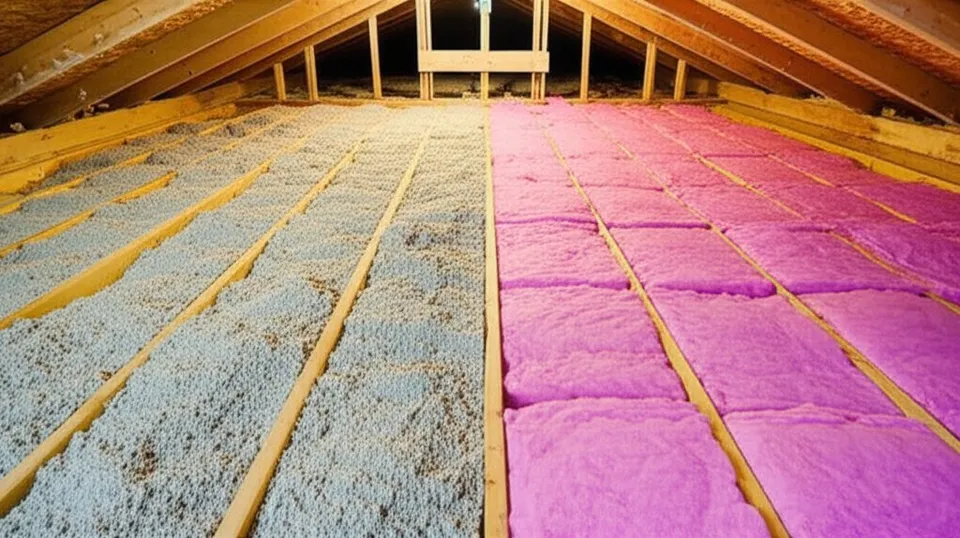
Quick Answer
For most Seattle attics, blown-in insulation wins. It fills irregular spaces completely, covers over joists to eliminate thermal bridging, and handles the obstacles you’ll find in real homes (wiring, ducts, pipes). Batts cost 15-25% less per square foot, but they tend to leave gaps that chip away at real-world R-value. Batts only make sense for open-wall new construction or when you need walkways across your attic floor.
Key takeaway: A 5% gap in insulation coverage can reduce a wall’s thermal performance by 20% or more. Blown-in’s ability to fill completely is its biggest practical advantage over batts.
Head-to-Head Comparison
| Factor | Blown-In | Batts | Winner |
|---|---|---|---|
| Cost per sq ft (installed) | $1.50-$2.75 | $1.25-$2.25 | Batts (15-25% less) |
| R-value per inch | R-2.5-R-3.7 | R-3.0-R-4.2 | Batts (mineral wool) |
| Real-world coverage | 95-100% fill | 80-90% typical | Blown-in |
| Air infiltration resistance | Good (dense-pack) | Poor | Blown-in |
| Installation speed | 3-4 hrs (1,200 sq ft attic) | 5-7 hrs | Blown-in |
| Obstacle handling | Fills around everything | Must be cut to fit | Blown-in |
| Moisture resistance | Moderate (fiberglass better) | Absorbs and sags | Blown-in |
| Thermal bridging | Covers joists | Joists exposed | Blown-in |
| DIY-friendly | No (requires equipment) | Yes | Batts |
R-Value Comparison by Material
Both types can hit the same target R-values. The real difference is how consistently they deliver that performance once they’re actually in your home.
| Material | R-Value Per Inch | Inches for R-49 (Attic) | Inches for R-21 (Wall) |
|---|---|---|---|
| Blown-in cellulose | R-3.5-R-3.7 | ~13-14” | ~6” |
| Blown-in fiberglass | R-2.5-R-3.0 | ~16-20” | ~7-8” |
| Fiberglass batts | R-3.0-R-3.7 | ~13-16” | ~6” |
| Mineral wool batts | R-3.7-R-4.2 | ~12-13” | ~5-6” |
On paper, the numbers are close. In practice, the gap widens because installation quality is the single biggest variable in insulation performance.
Why Installation Quality Matters More Than R-Value Rating
The Gap Problem with Batts
Here’s the thing about batts: they only hit their rated R-value when they’re installed perfectly. Full contact with all surfaces, no compression, no gaps. In real homes? That almost never happens.
Common issues we see in Puget Sound homes:
| Issue | How Often We See It | Impact on R-Value |
|---|---|---|
| Gaps around wiring and pipes | Very common | 15-25% reduction |
| Non-standard joist spacing | Common in pre-1990 homes | 10-20% reduction |
| Compression into tight spaces | Very common | Up to 50% reduction |
| Gaps at edges and corners | Common | 10-15% reduction |
| Missing coverage behind ducts | Very common | 20-30% reduction |
A batt rated at R-38 that’s compressed or has gaps may actually perform closer to R-25. Blown-in insulation avoids most of these issues because it conforms to whatever space it’s filling.
Thermal Bridging
In attics, insulation should extend over the top of joists for continuous coverage. When batts are laid between joists, the joists themselves become thermal bridges, basically direct paths for heat to escape through. Blown-in covers everything evenly, so that problem goes away.
Cost Comparison for Seattle-Area Projects
| Application | Blown-In (Installed) | Batts (Installed) | Cost Difference |
|---|---|---|---|
| Attic (1,200 sq ft to R-49) | $1,800-$3,300 | $1,500-$2,700 | Batts save $300-$600 |
| Wall cavity (exterior walls) | $2.00-$3.50/sq ft | $1.50-$2.50/sq ft | Batts save 25-30% |
| Crawl space floor | $2.00-$3.50/sq ft | $1.50-$2.75/sq ft | Batts save 15-20% |
Batts are typically 15-25% cheaper on materials. But here’s the catch: proper installation labor for batts in complex spaces can eat into those savings pretty quickly.
For a personalized estimate, our insulation cost calculator lets you compare costs by material type, area, and R-value target.
Best Choice by Location
Attics - Blown-In Wins
For open attic floors, blown-in is the clear winner in most Seattle homes. It covers the entire floor uniformly, buries joists to eliminate thermal bridging, and handles obstacles without any fussing around. That’s why our attic insulation service primarily uses blown-in materials.
The exception: If you’re using your attic for storage and need walkways, batts between joists with decking over them can work. Just know you’ll sacrifice some R-value at those joist locations.
Walls - Depends on the Situation
| Scenario | Best Choice | Why |
|---|---|---|
| New construction (open walls) | Batts (mineral wool) | Precise fitting before drywall |
| Gut renovation (open walls) | Batts (mineral wool) | Same as above |
| Existing home (closed walls) | Blown-in cellulose | Only option without removing drywall |
| Addition/remodel | Batts for open sections, blown-in for closed | Match approach to access |
Crawl Spaces - Both Have Issues
Traditional crawl space insulation, meaning batts between floor joists, has a rough track record in the Pacific Northwest. Fiberglass batts soak up moisture, start to sag, and eventually just fall right down. We see it all the time across the region.
Blown-in cellulose with proper netting holds up better, but honestly, the best approach for PNW crawl spaces usually starts with addressing moisture issues first and then insulating with materials suited to the environment.
Cellulose vs. Fiberglass Blown-In
If you’ve decided on blown-in, here’s how the two main materials stack up against each other:
| Property | Cellulose | Fiberglass |
|---|---|---|
| Made from | Recycled paper + borate | Spun glass fibers |
| R-value per inch | R-3.5-R-3.7 (higher) | R-2.5-R-3.0 |
| Air infiltration resistance | Better (denser) | Moderate |
| Moisture absorption | Higher | Lower |
| Settling over time | Moderate (installer compensates) | Minimal |
| Weight | Heavier | Lighter |
| Fire resistance | Borate-treated | Naturally non-combustible |
| Pest deterrence | Yes (borate) | No |
| Environmental | Recycled content | Recycled content possible |
For most Puget Sound attics, both perform well. Cellulose has a slight edge in air-sealing performance, while fiberglass has an edge in moisture resistance.
The Air Sealing Factor
This trips a lot of people up: neither blown-in nor batts are air barriers on their own. Insulation slows heat transfer. Air sealing stops air movement. They’re two different jobs that work together.
| Insulation Type | Air Sealing Ability | Recommendation |
|---|---|---|
| Dense-pack cellulose | Moderate air resistance | Still seal major penetrations |
| Loose-fill fiberglass | Minimal air resistance | Air sealing essential |
| Fiberglass batts | None | Air sealing essential |
| Spray foam | Excellent (combined insulation + air seal) | Premium option, 2-3x cost |
A solid insulation project should always include air sealing of major penetrations before any insulation goes in. We’re talking gaps around plumbing pipes, electrical wires, duct connections, and top plates. Skip this step and you’re leaving performance on the table.
Decision Summary
Choose blown-in if:
- You’re insulating an open attic floor (most common scenario)
- Your space has lots of obstacles, irregular framing, or limited access
- You want the fastest installation with the most complete coverage
- You’re insulating closed wall cavities in an existing home
- Air infiltration reduction is a priority
Choose batts if:
- You’re insulating during new construction or open-wall renovation
- The space has standard, obstacle-free framing and budget is tight
- You need attic walkways for storage access
- You want mineral wool’s fire resistance and soundproofing
Choose spray foam if:
- You need combined insulation and air sealing
- You’re insulating a roof deck (converting attic to conditioned space)
- Budget isn’t the primary constraint
Get a Recommendation for Your Home
Every home is different. Joist spacing, existing insulation condition, moisture levels, and access all factor into the best material choice. We look at all of this during our free estimates and recommend the approach that actually makes sense for your situation, not the material with the highest margin.
Get your free insulation estimate and we’ll evaluate your home, recommend the right material, and give you a written price. We provide insulation installation across King County and Snohomish County.

"R-value on the bag doesn't mean much if the installation leaves gaps. I've pulled batts rated at R-38 that were performing closer to R-25 because of compression and voids around wiring. The material only works as well as it's installed."
Sadeq, Owner
"When homeowners ask me cellulose or fiberglass, I look at the attic first. If there's any moisture history or the ventilation isn't great, fiberglass handles that better. If the attic is dry and well-vented, cellulose gives you a bit more R-value per inch and better air sealing. It really depends on the space."
Sadeq, Owner
Frequently Asked Questions
Is blown-in insulation better than batts for Seattle attics?
In most cases, yes. Blown-in insulation fills irregular spaces completely, covers over joists to eliminate thermal bridging, and handles obstacles like wiring and ducts without leaving gaps. Batts can work in clean, open attic floors, but real-world coverage with blown-in is typically 95-100% compared to 80-90% with batts.
How much more does blown-in insulation cost compared to batts?
Batts are usually 15-25% cheaper on materials. For a typical 1,200 sq ft Seattle attic insulated to R-49, blown-in runs about $1,800-$3,300 installed, while batts cost $1,500-$2,700. That said, labor costs for properly installing batts in tricky spaces can close the gap quickly.
Can I install blown-in insulation myself?
It's not recommended. Blown-in insulation requires specialized blowing equipment, proper depth gauges, and experience to achieve consistent coverage. Batts are more DIY-friendly since they come in pre-cut sizes, but even batts need careful fitting to perform well. Poorly installed insulation of either type won't deliver its rated R-value.
Should I use cellulose or fiberglass blown-in insulation?
Both work well in Puget Sound attics. Cellulose (made from recycled paper treated with borate) has a slightly higher R-value per inch and better air-sealing properties. Fiberglass resists moisture better and doesn't settle as much over time. Your installer can help you pick based on your attic's specific conditions.
Does insulation type affect air sealing?
Insulation and air sealing are two different jobs. Dense-pack cellulose provides moderate air resistance, but no insulation type replaces proper air sealing. Before any insulation goes in, gaps around plumbing pipes, electrical wires, duct connections, and top plates should all be sealed. That step matters just as much as the insulation itself.
How long does blown-in insulation last in Seattle's climate?
Blown-in insulation can last 20-30 years or more when installed properly in a dry, well-ventilated attic. The biggest threats in our climate are moisture intrusion and pest damage. Cellulose treated with borate naturally deters pests, which is a nice bonus for Pacific Northwest homes.